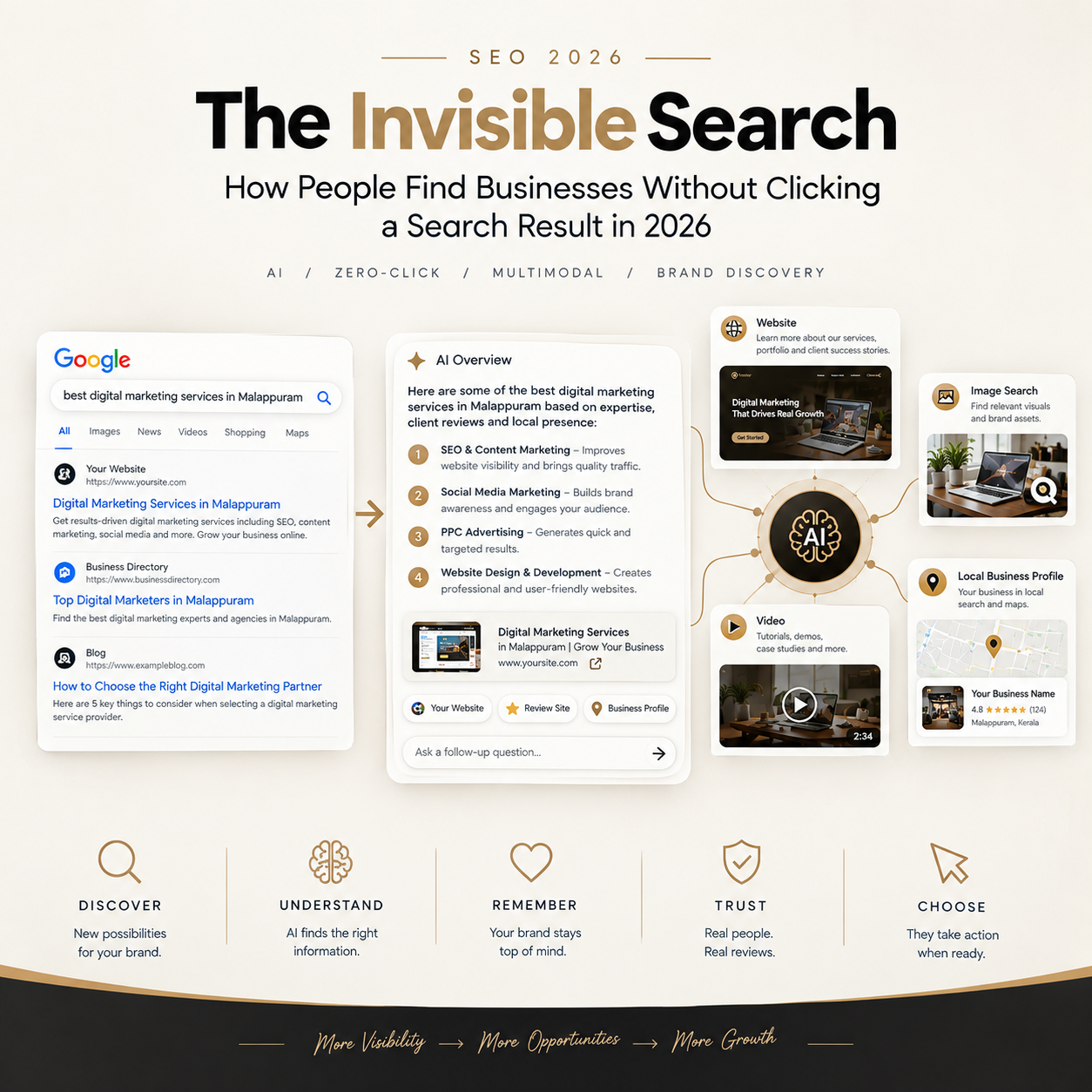
By Naswiha Nasarin | Freelance Digital Marketer Introduction: What If Your Customer Finds You Without Visiting Your Website? For years, digital marketers were trained to think about search in a relatively simple sequence: User searches → Search engine displays results → User clicks → User visits website → User converts. That model still exists. But in 2026, it no longer describes the entire search journey. People can now discover businesses and information through AI-powered search experiences, AI-generated answers, images, videos, Google Lens, Circle to Search, local business information, and other search interfaces. Sometimes, the user may see your information without immediately clicking through to your website. This creates an important question for modern SEO: What happens when your website influences someone’s decision even when that person never visits your website? This is the idea behind Invisible Search. Invisible Search is a way of thinking about search-driven discovery that happens beyond the traditional search → click → website journey. Google’s current guidance explains that generative AI search experiences continue to rely on established search systems and that traditional SEO fundamentals remain important. Google also emphasizes the value of unique, useful content and relevant multimedia. For businesses and digital marketers, this means SEO is becoming broader than rankings and clicks. The goal is increasingly to become discoverable, understandable, useful and trustworthy wherever a potential customer searches for information. What Is Invisible Search? Invisible Search describes search-driven discovery that may influence a user even when the interaction does not immediately result in a traditional website visit. This can include visibility through: AI-generated search responses AI Overviews AI Mode Search snippets Image search Google Lens Circle to Search Video results Local business information Brand mentions Other AI-assisted discovery experiences The word “invisible” does not mean that your business is literally hidden. It refers to the fact that some of the influence generated by search may happen outside the traditional website-traffic measurement model. A customer might discover your brand today, remember it, search for it later, and eventually become a customer through a completely different channel. The first search interaction may therefore be invisible in the final conversion journey. Modern SEO is increasingly about being discovered before the website click happens. The Old SEO Equation Is Changing Traditional SEO measurement has often focused on: Rankings → Clicks → Traffic A marketer might ask: “How many clicks did this keyword generate?” That remains an important question. But consider a different situation. Someone searches: “Who can help a small business improve its digital marketing?” An AI-powered search experience may provide an answer using information gathered from multiple sources. The user may notice a professional or company name. They may remember it. Later, they might search that brand directly. They may visit its website through a branded search. The original discovery therefore influenced the customer even though the first search did not necessarily create a website session. The journey becomes: Search → Discovery → Recognition → Trust → Brand Search → Website → Conversion The website click has moved further down the journey. The Rise of the AI-Mediated Search Journey The traditional search journey might look like this: User searches ↓ Search results appear ↓ User opens several websites ↓ User compares information ↓ User chooses a business The AI-mediated journey can be different: User asks a detailed question ↓ Search system interprets the question ↓ Related information is gathered ↓ AI-generated response provides an explanation ↓ Supporting sources or businesses may be presented ↓ User investigates a brand ↓ User eventually converts Google’s documentation describes AI search systems that can use multiple related searches to gather information before producing a response. This means modern SEO needs to focus not only on matching a specific search phrase but also on providing information that satisfies the underlying user need. From Exact Keywords to Search Intent One of the biggest mindset changes in SEO is moving away from excessive focus on exact keyword repetition. Consider the keyword: “digital marketing expert in Malappuram” A traditional approach might place that exact phrase repeatedly throughout a webpage. Modern SEO should instead understand the broader intent behind the search. A potential customer could ask: “Who can manage online marketing for my business in Malappuram?” Another might ask: “How can a small business in Malappuram get more customers online?” Another might search: “What should I look for when hiring a freelance digital marketer?” These searches use different words, but they can represent closely related needs. Google’s documentation explains that its systems can understand related language and synonyms, meaning content does not need to repeat every possible variation of a keyword. The better question is: What problem does my content solve? Instead of: How many times did I use my keyword? From Keyword Visibility to Concept Visibility This leads to a broader SEO concept: concept visibility. Imagine your website is about digital marketing. Your main topic might connect naturally to: SEO Content marketing Social media marketing Paid advertising Email marketing Analytics AI marketing Local SEO Conversion optimization Instead of creating isolated pages for every keyword, build a connected ecosystem of useful information. Example topic cluster Main Topic: Digital Marketing Supporting Topic: SEO Keyword research Technical SEO Local SEO On-page SEO Content SEO Supporting Topic: Paid Advertising Google Ads Meta Ads PPC strategy Conversion tracking Supporting Topic: Content Marketing Blog strategy Copywriting Content planning AI-assisted content The goal is not to manipulate search engines. The goal is to build a website that genuinely explains a subject from multiple useful perspectives. The New Content Advantage: Be the Source, Not Just the Answer Imagine an AI system is answering: “What are the benefits of SEO for a small business?” Your article may not become the entire answer. But it could contain useful information that contributes to the search ecosystem around that subject. This changes the role of content. Instead of creating pages only to capture one keyword, create resources that are worth discovering, referencing and returning to. Google’s 2026 guidance emphasizes unique and