By Naswiha Nasarin | Freelance Digital Marketer
Table of Contents
ToggleIntroduction: What If Your Customer Finds You Without Visiting Your Website?
For years, digital marketers were trained to think about search in a relatively simple sequence:
User searches → Search engine displays results → User clicks → User visits website → User converts.
That model still exists.
But in 2026, it no longer describes the entire search journey.
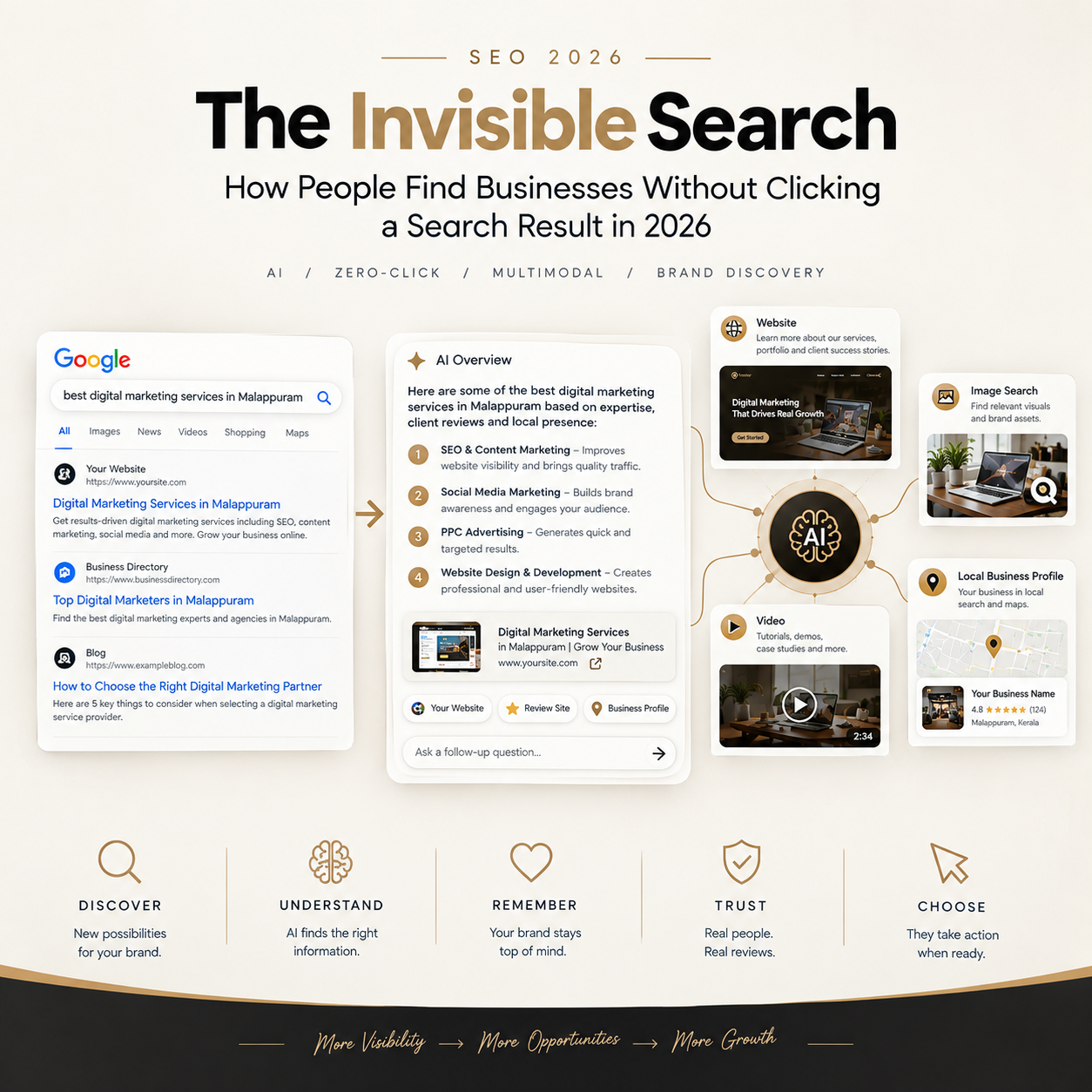
People can now discover businesses and information through AI-powered search experiences, AI-generated answers, images, videos, Google Lens, Circle to Search, local business information, and other search interfaces.
Sometimes, the user may see your information without immediately clicking through to your website.
This creates an important question for modern SEO:
What happens when your website influences someone’s decision even when that person never visits your website?
This is the idea behind Invisible Search.
Invisible Search is a way of thinking about search-driven discovery that happens beyond the traditional search → click → website journey.
Google’s current guidance explains that generative AI search experiences continue to rely on established search systems and that traditional SEO fundamentals remain important. Google also emphasizes the value of unique, useful content and relevant multimedia.
For businesses and digital marketers, this means SEO is becoming broader than rankings and clicks.
The goal is increasingly to become discoverable, understandable, useful and trustworthy wherever a potential customer searches for information.
What Is Invisible Search?
Invisible Search describes search-driven discovery that may influence a user even when the interaction does not immediately result in a traditional website visit.
This can include visibility through:
-
- AI-generated search responses
-
- AI Overviews
-
- AI Mode
-
- Search snippets
-
- Image search
-
- Google Lens
-
- Circle to Search
-
- Video results
-
- Local business information
-
- Brand mentions
-
- Other AI-assisted discovery experiences
The word “invisible” does not mean that your business is literally hidden.
It refers to the fact that some of the influence generated by search may happen outside the traditional website-traffic measurement model.
A customer might discover your brand today, remember it, search for it later, and eventually become a customer through a completely different channel.
The first search interaction may therefore be invisible in the final conversion journey.
Modern SEO is increasingly about being discovered before the website click happens.
The Old SEO Equation Is Changing
Traditional SEO measurement has often focused on:
Rankings → Clicks → Traffic
A marketer might ask:
“How many clicks did this keyword generate?”
That remains an important question.
But consider a different situation.
Someone searches:
“Who can help a small business improve its digital marketing?”
An AI-powered search experience may provide an answer using information gathered from multiple sources.
The user may notice a professional or company name.
They may remember it.
Later, they might search that brand directly.
They may visit its website through a branded search.
The original discovery therefore influenced the customer even though the first search did not necessarily create a website session.
The journey becomes:
Search → Discovery → Recognition → Trust → Brand Search → Website → Conversion
The website click has moved further down the journey.
The Rise of the AI-Mediated Search Journey
The traditional search journey might look like this:
User searches
↓
Search results appear
↓
User opens several websites
↓
User compares information
↓
User chooses a business
The AI-mediated journey can be different:
User asks a detailed question
↓
Search system interprets the question
↓
Related information is gathered
↓
AI-generated response provides an explanation
↓
Supporting sources or businesses may be presented
↓
User investigates a brand
↓
User eventually converts
Google’s documentation describes AI search systems that can use multiple related searches to gather information before producing a response.
This means modern SEO needs to focus not only on matching a specific search phrase but also on providing information that satisfies the underlying user need.
From Exact Keywords to Search Intent
One of the biggest mindset changes in SEO is moving away from excessive focus on exact keyword repetition.
Consider the keyword:
“digital marketing expert in Malappuram”
A traditional approach might place that exact phrase repeatedly throughout a webpage.
Modern SEO should instead understand the broader intent behind the search.
A potential customer could ask:
“Who can manage online marketing for my business in Malappuram?”
Another might ask:
“How can a small business in Malappuram get more customers online?”
Another might search:
“What should I look for when hiring a freelance digital marketer?”
These searches use different words, but they can represent closely related needs.
Google’s documentation explains that its systems can understand related language and synonyms, meaning content does not need to repeat every possible variation of a keyword.
The better question is:
What problem does my content solve?
Instead of:
How many times did I use my keyword?
From Keyword Visibility to Concept Visibility
This leads to a broader SEO concept: concept visibility.
Imagine your website is about digital marketing.
Your main topic might connect naturally to:
-
- SEO
-
- Content marketing
-
- Social media marketing
-
- Paid advertising
-
- Email marketing
-
- Analytics
-
- AI marketing
-
- Local SEO
-
- Conversion optimization
Instead of creating isolated pages for every keyword, build a connected ecosystem of useful information.
Example topic cluster
Main Topic: Digital Marketing
Supporting Topic: SEO
-
- Keyword research
-
- Technical SEO
-
- Local SEO
-
- On-page SEO
-
- Content SEO
Supporting Topic: Paid Advertising
-
- Google Ads
-
- Meta Ads
-
- PPC strategy
-
- Conversion tracking
Supporting Topic: Content Marketing
-
- Blog strategy
-
- Copywriting
-
- Content planning
-
- AI-assisted content
The goal is not to manipulate search engines.
The goal is to build a website that genuinely explains a subject from multiple useful perspectives.
The New Content Advantage: Be the Source, Not Just the Answer
Imagine an AI system is answering:
“What are the benefits of SEO for a small business?”
Your article may not become the entire answer.
But it could contain useful information that contributes to the search ecosystem around that subject.
This changes the role of content.
Instead of creating pages only to capture one keyword, create resources that are worth discovering, referencing and returning to.
Google’s 2026 guidance emphasizes unique and valuable content and highlights the importance of distinctive viewpoints and first-hand experience.
This creates an important advantage for businesses that can demonstrate something genuinely useful.
The Commodity Content Problem
Imagine thousands of websites publish:
10 Benefits of Digital Marketing
Many of those articles will contain almost identical information.
Now compare that with:
What I Learned While Building a Digital Marketing Strategy for a Small Local Brand With a Limited Budget
The second topic has a different quality.
It can contain:
-
- Real observations
-
- Decisions
-
- Experiments
-
- Problems
-
- Solutions
-
- Results
-
- Lessons
-
- Practical recommendations
That makes it more distinctive.
Why does this matter?
Because generic information is increasingly easy to reproduce.
Original experiences are harder to replicate.
The more easily information can be generated, the more valuable genuine experience and original insight can become.
AI Doesn’t Make Human Experience Less Valuable
Artificial intelligence can generate definitions, outlines, summaries and generic explanations extremely quickly.
That does not necessarily make human expertise irrelevant.
Instead, AI may make generic information less distinctive while increasing the value of unique information.
Consider two articles.
Article A
“SEO stands for Search Engine Optimization. It helps websites improve their visibility in search engines.”
Useful—but generic.
Article B
“During an SEO audit, I discovered that a client’s biggest visibility problem wasn’t keyword targeting. Important service pages were difficult for both users and search engines to discover.”
The second example contains an observation.
It communicates experience.
It gives the reader something they can learn from.
This is why marketers should use AI as an assistant rather than treating it as a substitute for expertise, verification and original thinking.
Multimodal Search: When Keywords Are No Longer the Starting Point
Search is increasingly becoming multimodal.
People can discover information through:
-
- Text
-
- Images
-
- Camera searches
-
- Video
-
- Voice
-
- Visual search
-
- AI-generated responses
In September 2026, Google announced new multimodal search reporting in Search Console covering search interactions involving Google Lens, Circle to Search on Android, image uploads to Google Search and Chrome’s “Search this image” feature.
This introduces another important SEO question:
What happens when your customer searches with an image instead of a keyword?
The Rise of Visual SEO
Many businesses still treat images as decoration.
But an image can communicate information about:
-
- Products
-
- Services
-
- Locations
-
- People
-
- Designs
-
- Processes
-
- Demonstrations
-
- Branding
Therefore, images should become part of your SEO strategy.
Image SEO checklist
Use:
-
- Descriptive filenames
-
- Relevant alt text
-
- High-quality original images
-
- Appropriate dimensions
-
- Useful captions when relevant
-
- Contextual text around images
-
- Structured data where appropriate
Instead of:
IMG_4839.jpg
consider a descriptive filename such as:
malappuram-local-seo-strategy.jpg
However, image SEO is not simply about changing filenames.
The image should be genuinely relevant to the page and useful to the user.
Video Is Another Searchable Knowledge Layer
Some information is easier to understand through video than text.
For example:
“How to optimize a Google Business Profile”
can be explained through an article.
But a short demonstration can show the process visually.
Businesses can create:
-
- Tutorials
-
- Demonstrations
-
- Case studies
-
- Interviews
-
- FAQs
-
- Educational videos
-
- Behind-the-scenes content
-
- Step-by-step guides
A single topic can therefore become:
Blog + Video + Image + Social Content + FAQ
The goal is not to duplicate content everywhere.
The goal is to give users different ways to understand useful information.
The New Meaning of Website Traffic
Website traffic remains important.
But traffic alone does not tell the complete story.
Imagine two businesses.
Business A
100,000 website visits
but:
-
- Low trust
-
- Weak brand recognition
-
- Poor conversion rate
-
- Generic content
Business B
20,000 website visits
but:
-
- Strong brand recognition
-
- High-intent visitors
-
- Strong repeat searches
-
- Useful content
-
- Better conversion
Website traffic alone cannot describe the entire business impact.
That is why modern SEO measurement should consider multiple dimensions.
Measure:
-
- Impressions
-
- Clicks
-
- CTR
-
- Rankings
-
- Brand searches
-
- Leads
-
- Conversions
-
- AI visibility
-
- Image visibility
-
- Video visibility
-
- Returning users
Search Console as a Visibility Observatory
Google Search Console has traditionally helped website owners understand:
-
- Search queries
-
- Clicks
-
- Impressions
-
- CTR
-
- Average position
-
- Indexing
-
- Core Web Vitals
In 2026, Google expanded reporting related to newer search experiences.
Google introduced reporting for generative AI search experiences and later added multimodal search reporting.
This makes Search Console increasingly useful for understanding where and how your content is being discovered.
Instead of treating Search Console simply as a ranking report, think of it as a visibility observatory.
Ask:
Where are people discovering my content?
Which pages are gaining visibility?
Which topics are attracting impressions?
Which search experiences are changing?
Which content produces meaningful business outcomes?
The New SEO Funnel
The modern SEO journey can be understood as five stages.
1. Discovery
A potential customer encounters your:
-
- Website
-
- Image
-
- Video
-
- Business profile
-
- Brand
-
- AI search result
2. Recognition
The customer remembers:
“I’ve seen this brand before.”
3. Investigation
They search for:
-
- Brand name
-
- Services
-
- Reviews
-
- Portfolio
-
- Social media
4. Trust
They encounter:
-
- Helpful articles
-
- Case studies
-
- Testimonials
-
- Professional information
-
- Demonstrations
-
- Genuine experience
5. Conversion
They:
-
- Contact you
-
- Call
-
- Book
-
- Purchase
-
- Subscribe
-
- Request a quote
This shows why SEO increasingly overlaps with branding, content marketing, user experience and conversion optimization.
Brand Visibility Matters More Than Artificial Mentions
The rise of AI search has created a new temptation:
“If AI systems look for mentions, I’ll create thousands of mentions of my brand.”
This is not a sustainable strategy.
Artificial or manipulative mentions do not create genuine authority.
Instead, build legitimate visibility through:
-
- Original content
-
- Professional contributions
-
- Genuine partnerships
-
- Customer experiences
-
- Interviews
-
- Research
-
- Relevant publications
-
- Useful educational resources
The objective should be reputation, not artificial noise.
Don’t try to make your brand appear everywhere. Make your brand worth mentioning in the right places.
GEO, AEO and the New Language of SEO
You may have heard terms such as:
GEO — Generative Engine Optimization
and
AEO — Answer Engine Optimization
These terms are increasingly used by marketers to describe visibility within AI-powered answers and answer-oriented search experiences.
But businesses should avoid treating them as completely separate from SEO.
Google’s own guidance states that established SEO best practices remain foundational for AI-powered search experiences.
That means your strategy should still prioritize:
-
- Helpful content
-
- Crawlability
-
- Technical SEO
-
- Search intent
-
- Original value
-
- Clear structure
-
- Relevant multimedia
-
- Trust
There is no need to abandon SEO fundamentals simply because search interfaces are changing.
Don’t Build Your SEO Strategy Around Secret AI Tricks
As AI search becomes more popular, more tools and services are appearing with claims about secret optimization methods.
Be cautious.
There is no guaranteed paragraph format that automatically makes an AI system recommend your business.
There is no magic keyword density.
There is no guaranteed shortcut to AI visibility.
Google’s documentation also states that third-party SEO tools do not have access to Google’s internal ranking or AI systems.
The sustainable approach is still:
Useful content + technical accessibility + genuine expertise + clear information + continuous measurement
The Website Must Be Machine-Readable and Human-Friendly
A modern website needs to work for both humans and search systems.
Make information easy to understand
Use:
-
- Clear navigation
-
- Descriptive headings
-
- Logical page structure
-
- Crawlable links
-
- Accessible content
-
- Appropriate structured data
-
- Descriptive images
But don’t write for machines at the expense of people.
Your website should still sound natural.
Google’s guidance does not require websites to break content into tiny fragments or follow a specific page length for AI search.
The right structure depends on the subject and the audience.
The Invisible Search Strategy for Small Businesses
A small business does not need thousands of pages to become discoverable.
Instead, build a connected search ecosystem.
Website
Create strong service and information pages.
Blog
Publish original expertise and useful answers.
Images
Use relevant original visual content.
Video
Demonstrate processes and answer questions.
Local SEO
Maintain accurate business information.
Social Media
Share useful insights rather than only advertisements.
Reviews
Collect genuine customer feedback.
Analytics
Measure visibility, engagement and business outcomes.
The customer might discover your business through any one of these channels.
That is the strength of a connected digital presence.
The Invisible Search Framework
Here is a practical framework that digital marketers can use.
S — Source
Create information worth discovering and referencing.
E — Experience
Add genuine observations, practical lessons and first-hand knowledge.
A — Accessibility
Make your content technically and visually accessible.
R — Relevance
Answer real questions and satisfy search intent.
C — Context
Connect your content with related subjects.
H — Human Trust
Clearly communicate who created the content and why the audience should trust it.
SEARCH =
Source + Experience + Accessibility + Relevance + Context + Human Trust
This is not a Google ranking formula.
It is a strategic framework for thinking about modern search visibility.
What Should SEO Professionals Measure in 2026?
A modern SEO dashboard can include several categories.
| Area | What to Monitor |
|---|---|
| Traditional Search | Impressions, clicks, CTR |
| Rankings | Position trends |
| AI Search | Generative AI visibility |
| Content | Engagement and conversions |
| Brand | Branded searches |
| Images | Multimodal visibility |
| Video | Views and assisted conversions |
| Local SEO | Local discovery and actions |
| Technical SEO | Indexing and crawl issues |
| Business | Leads, enquiries and sales |
The important change is that ranking should no longer be the only KPI.
A ranking can create visibility.
Visibility can create recognition.
Recognition can create branded searches.
Branded searches can create website visits.
Website visits can create conversions.
SEO therefore needs to be evaluated as part of the complete customer journey.
The Biggest SEO Mistake of 2026
The biggest mistake may not be:
“My website isn’t ranking.”
It may be:
“I’m measuring only what happens after the click.”
A customer may discover your business through an AI search experience.
They may see your image.
They may watch your video.
They may encounter your brand while researching a problem.
They may search your brand several days later.
They may finally visit your website through a branded query.
If you look only at the final website visit, you may miss part of the discovery journey.
What This Means for Your SEO Strategy
The traditional model was:
Rank → Click → Visit → Convert
A broader 2026 model is:
Discover → Understand → Remember → Trust → Visit → Convert
This means SEO professionals increasingly need to work alongside:
-
- Content marketing
-
- Branding
-
- Social media
-
- Video marketing
-
- Local SEO
-
- User experience
-
- Analytics
-
- Conversion optimization
-
- AI-assisted workflows
SEO is no longer an isolated technical activity.
It is becoming part of a broader digital discovery strategy.
The Future Question Isn’t “How Do I Rank?”
Perhaps the most important mindset change is this:
Instead of asking:
“How do I rank first?”
start asking:
“How can my business become the most useful and trusted source when someone is researching this problem?”
That question changes your strategy.
You start creating:
-
- Better content
-
- Better explanations
-
- Better examples
-
- Better visuals
-
- Better videos
-
- Better user experiences
-
- Better evidence
-
- Better brand signals
And ultimately, this brings us back to one of the most important principles of SEO:
Help people first.
Conclusion: SEO Is Becoming Invisible—and That Is Not a Bad Thing
SEO in 2026 is entering an important new phase.
The search result is no longer always the final destination.
Sometimes it is an answer.
Sometimes it is an image.
Sometimes it is a video.
Sometimes it is an AI-generated explanation.
And sometimes it is simply the first moment when someone discovers your brand.
Google’s 2026 guidance reinforces the importance of strong SEO fundamentals while emphasizing valuable, distinctive content, relevant images and videos, and genuine user value.
The expansion of Search Console reporting for generative AI and multimodal search also shows that search visibility is becoming more diverse than traditional blue-link rankings.
So perhaps the future of SEO isn’t simply about getting more clicks.
It is about creating more opportunities for people to discover, recognize, trust and choose your brand.
That is the idea behind Invisible Search.
And for digital marketers, it creates a new strategic challenge:
Don’t optimize only for where your website appears. Optimize for where your expertise can be discovered.
Final Takeaway
SEO in 2026 is not disappearing. It is expanding.
The businesses that adapt will think beyond keywords and rankings.
They will build:
Useful content + Technical SEO + Original expertise + Multimedia + Brand trust + AI-search visibility
The future belongs not simply to websites that rank.
It belongs to businesses that become discoverable wherever their customers are searching for answers.
Work With Me
If you’re looking to improve your website’s visibility, strengthen your online presence, or build a practical SEO and digital marketing strategy, I’d love to help.
As a freelance digital marketer in Malappuram, I focus on combining SEO, content marketing, social media, paid advertising, analytics and AI-powered marketing approaches to help businesses build a stronger digital presence.
Ready to improve your digital visibility?
Let’s work together and turn your online presence into a growth opportunity.
References
Google Search Central. AI Features and Your Website.
Google Search Central. AI Features and Your Website — Optimizing for Generative AI Features.
Google Search Central. Generative AI Performance Reports in Search Console.
Google Search Central. Multimodal Search Performance Reporting.
Google Search Central. Search Essentials and Spam Policies.