By Naswiha Nasarin | Freelance Digital Marketer
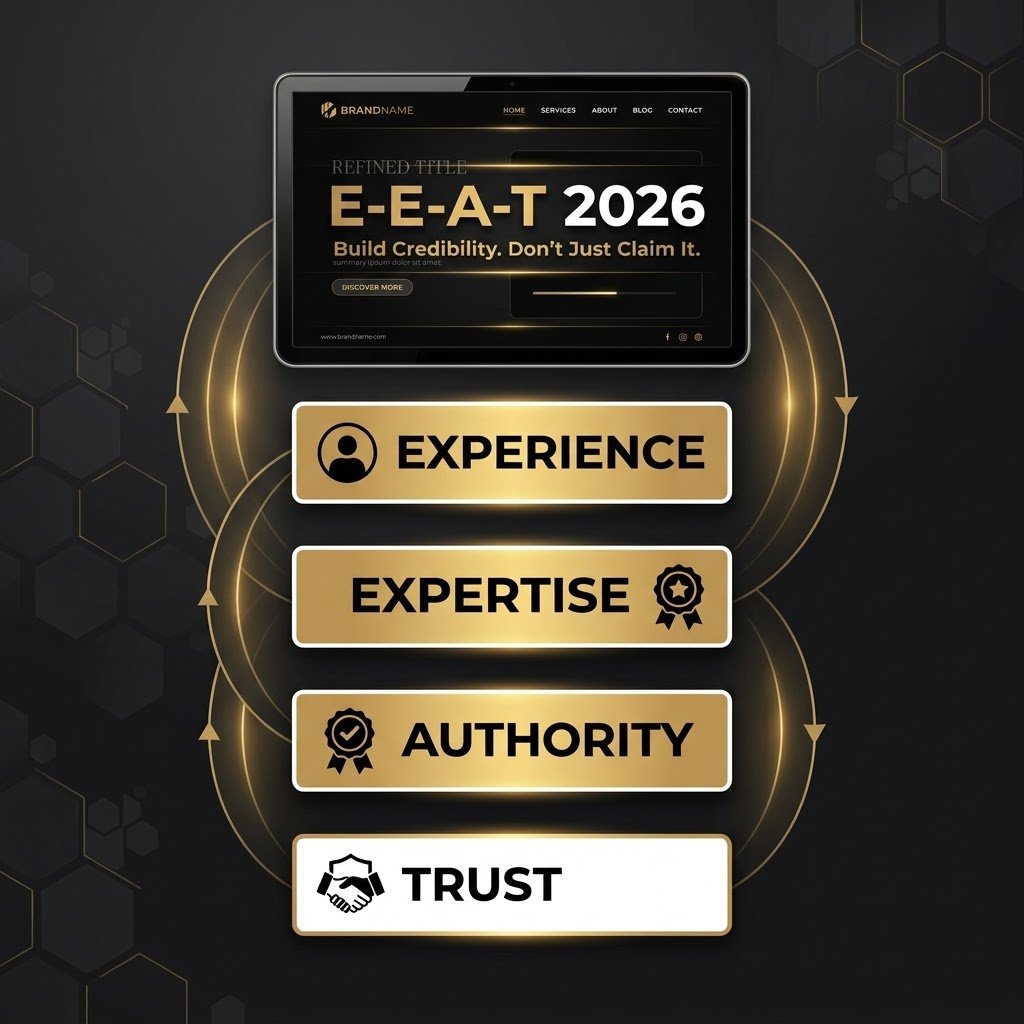
E-E-A-T SEO 2026
A website can look professional without being trustworthy.
It can have beautiful graphics, carefully written pages, impressive animations and strong SEO.
But when someone lands on your website, one question remains:
“Why should I trust this website?”
That question is at the heart of modern digital visibility.
In 2026, building an online presence is no longer simply about publishing content and trying to rank for keywords. Businesses, professionals and personal brands need to demonstrate who they are, what they know, what they have experienced and why their information deserves attention.
This is where E-E-A-T — Experience, Expertise, Authoritativeness and Trustworthiness — becomes important.
E-E-A-T provides a useful framework for thinking about the credibility of your website and its content.
It is not a magic SEO score.
It is not a plugin.
And it is not something you can create simply by writing “expert” on your website.
Instead, strong E-E-A-T is demonstrated through the total experience your website provides.
Table of Contents
ToggleWhat Is E-E-A-T?
E-E-A-T stands for:
Experience
Have you personally experienced, used, tested, practiced or worked with the subject you are discussing?
Expertise
Do you demonstrate relevant knowledge and understanding of the topic?
Authoritativeness
Do other credible people, websites or organizations recognize your knowledge or work?
Trustworthiness
Can visitors trust the information, people, business and processes behind your website?
Among these concepts, trust is particularly important.
Google’s Search Central guidance explains that E-E-A-T itself is not a specific ranking factor or a single score. Instead, Google’s systems use a range of signals that can identify content demonstrating aspects of E-E-A-T.
That distinction matters.
You should not approach E-E-A-T as:
“How do I get an E-E-A-T score?”
A better question is:
“How can my website demonstrate that the information, people and business behind it are trustworthy?”
Why E-E-A-T Matters for Websites in 2026
The modern search journey is becoming increasingly complex.
A person may discover a brand through:
-
- Google Search
-
- AI-generated search experiences
-
- Images
-
- Videos
-
- Social media
-
- Maps
-
- Reviews
-
- Online communities
-
- Brand mentions
-
- Recommendations
-
- Direct searches for a person’s name or business
This means your website is no longer operating in isolation.
Your website becomes part of a larger digital identity ecosystem.
A visitor may discover your name somewhere else and then visit your website to verify you.
They may read one of your blog posts before looking at your services.
They may check your About page.
They may look for evidence of your experience.
They may search for reviews.
They may want to know whether your contact information is genuine.
The website therefore has an important role:
It should make your credibility easier to understand and verify.
E-E-A-T Is More Than SEO
One of the biggest misunderstandings about E-E-A-T is treating it as an SEO trick.
It isn’t.
Imagine two websites offering the same service.
Website A says:
“We are the best digital marketing experts.”
Website B explains:
-
- who runs the business
-
- what experience they have
-
- what services they provide
-
- how they work
-
- what tools they use
-
- what qualifications they have
-
- what projects they have completed
-
- what clients say about them
-
- how visitors can contact them
-
- where their information comes from
The second website gives visitors more information with which to evaluate credibility.
That is the practical value of E-E-A-T.
Don’t just claim credibility. Demonstrate it.
The Relationship Between E-E-A-T and Your Website
E-E-A-T can be reflected across almost every part of your website.
Think of your website as a collection of trust signals.
Homepage
Communicates who you are and what you do.
About Page
Explains your background, experience and identity.
Services Page
Shows what you offer and how you approach your work.
Portfolio
Provides evidence of practical work.
Blog
Demonstrates knowledge and expertise.
Testimonials
Provide genuine customer experiences.
Contact Page
Makes your business identity and communication channels transparent.
Certifications
Provide evidence of relevant education or training.
Case Studies
Demonstrate real-world experience and outcomes where claims can be supported.
Author Information
Connects content with a real person.
When these elements work together, your website becomes more than an online brochure.
It becomes a digital proof system.
1. Experience: Show What You Have Actually Done
The first “E” represents Experience.
Experience is about demonstrating first-hand involvement with the subject.
For example, instead of writing:
“SEO is important for businesses.”
You could explain:
“While developing my digital marketing skills, I have been exploring how SEO connects technical optimization, content strategy and user intent.”
The second statement provides context about the author’s relationship with the topic.
Experience can be demonstrated through:
-
- personal observations
-
- project work
-
- practical examples
-
- case studies
-
- screenshots
-
- experiments
-
- lessons learned
-
- original research
-
- before-and-after examples
-
- documented processes
-
- real client experiences, when permission allows
For a personal-brand website
Create an Experience section that answers:
What have I actually done?
For example:
-
- Digital marketing projects
-
- SEO learning and implementation
-
- Content strategy work
-
- Website projects
-
- Campaign experiments
-
- Analytics practice
-
- Certifications
-
- Professional development
Do not exaggerate.
A smaller amount of genuine experience is more credible than a large collection of unsupported claims.
2. Expertise: Demonstrate What You Know
Expertise is about knowledge.
But expertise should not simply be announced.
Instead of repeatedly saying:
“I am a digital marketing expert.”
your website can demonstrate knowledge through useful content.
For example:
-
- SEO guides
-
- Digital marketing explanations
-
- Industry analysis
-
- Practical tutorials
-
- Case studies
-
- Original frameworks
-
- Research-based articles
-
- Data interpretation
-
- Marketing experiments
-
- Frequently asked questions
Your blog can become an important part of your expertise layer.
Every high-quality article gives visitors another opportunity to understand how you think.
A useful principle
Don’t use your blog only to attract traffic.
Use it to demonstrate how you solve problems.
3. Authoritativeness: Build Recognition
Authority is not something you simply assign to yourself.
It develops through recognition.
Your authority ecosystem can include:
-
- Professional profiles
-
- Relevant certifications
-
- Published articles
-
- Industry mentions
-
- Genuine testimonials
-
- Partnerships
-
- Interviews
-
- Professional communities
-
- Relevant backlinks
-
- Speaking opportunities
-
- Portfolio work
-
- Consistent professional identity
For a personal brand, consistency is especially important.
Your name, professional description, profile image and areas of expertise should be reasonably consistent across your professional online presence.
This helps people understand that different profiles belong to the same person.
4. Trustworthiness: The Foundation of E-E-A-T
Trust is where everything comes together.
A visitor should be able to understand:
Who created this website?
Who created this content?
How can I contact them?
Is the information supported?
Are the claims realistic?
Are testimonials genuine?
Are qualifications accurately represented?
Is the website secure?
Is the business identity clear?
These questions matter because a polished design cannot compensate for misleading information.
Trust can be strengthened through:
-
- Real author information
-
- Accurate contact information
-
- Transparent business information
-
- Genuine testimonials
-
- Clear service descriptions
-
- Honest claims
-
- Reliable references
-
- Updated content
-
- Secure website infrastructure
-
- Professional privacy and legal pages
-
- Clear ownership
-
- Consistent branding
Trust is not created by one element.
It is created by consistency.
Your About Page Is an E-E-A-T Asset
Many personal websites treat the About page as an afterthought.
It shouldn’t be.
For a personal brand, the About page can answer the fundamental question:
“Who is behind this website?”
Your About page can include:
Who you are
Your name and professional role.
Your background
Your education and professional journey.
Your skills
The areas you actively work in or are developing.
Your experience
Relevant projects, internships, work or practical learning.
Your approach
How you think about digital marketing.
Your professional goals
The type of work and problems you want to help solve.
Your credentials
Relevant certifications and education.
Your professional links
Relevant professional profiles.
The objective isn’t to make the page longer.
The objective is to make your identity clearer.
Your Blog Is an E-E-A-T Demonstration Layer
Your blog can do much more than generate website traffic.
It can demonstrate your thinking.
For example, instead of publishing only generic articles such as:
“10 Digital Marketing Tips”
you can develop original perspectives around topics such as:
-
- E-E-A-T and website credibility
-
- Invisible Search
-
- Multimodal SEO
-
- AI search visibility
-
- Search intent
-
- Digital reputation
-
- Personal branding
-
- AI-assisted marketing
-
- Search behaviour
-
- Content strategy
-
- Local digital visibility
A focused content library helps visitors understand the subjects you care about.
Evidence Makes Content More Credible
Whenever you make an important factual claim, consider whether you can support it.
Evidence can include:
-
- Official documentation
-
- Research studies
-
- Industry reports
-
- Original data
-
- Screenshots
-
- First-hand observations
-
- Expert interviews
-
- Case studies
-
- Credible publications
For example, instead of writing:
“Google says E-E-A-T is important for every ranking.”
that would be an oversimplification.
A more accurate explanation is:
“Google describes E-E-A-T as a framework for understanding qualities such as experience, expertise, authoritativeness and trustworthiness, while noting that E-E-A-T itself is not a specific ranking factor.”
Precision increases credibility.
Make Your Website Clear to People and Machines
A modern website needs to communicate its meaning clearly.
This includes both human visitors and search systems.
Your website should have:
-
- Clear page titles
-
- Logical headings
-
- Descriptive URLs
-
- Helpful internal links
-
- Descriptive image alt text
-
- Clear author information
-
- Consistent business information
-
- Accessible content
-
- Relevant structured data
-
- Easy navigation
Structured data can help search engines understand what a page represents.
For example, a blog article can use appropriate Article/BlogPosting structured data, including information about the headline, author and dates. Google recommends using relevant structured-data properties and validating the implementation.
But remember:
Structured data does not create credibility by itself.
The information represented in structured data should accurately reflect visible page content.
E-E-A-T and AI Search in 2026
Search is expanding beyond traditional blue links.
Google’s 2026 guidance on generative AI search emphasizes that established SEO fundamentals remain relevant and that websites should continue creating valuable, unique, people-first content.
This creates an important opportunity for websites.
Content that clearly communicates:
-
- who created it
-
- what the subject is
-
- where information comes from
-
- what evidence supports important claims
-
- why the content exists
-
- what practical value it provides
can be easier for both humans and systems to understand.
However, E-E-A-T should not be marketed as a guaranteed method for appearing in AI-generated answers.
There is no legitimate formula such as:
E-E-A-T + Schema = AI citation
Search visibility is more complex than that.
The better strategy is to create content that is genuinely useful, clearly authored, well-supported and easy to understand.
What About AI-Generated Content?
AI tools are increasingly becoming part of content creation.
The important question is not simply:
“Was AI used?”
A more useful question is:
“Was the resulting content useful, accurate, original and created for people?”
AI can help with:
-
- Brainstorming
-
- Research organization
-
- Outlining
-
- Editing
-
- Content ideation
-
- Summarization
-
- Workflow automation
But human responsibility remains important.
Before publishing AI-assisted content, check:
-
- factual accuracy
-
- originality
-
- sources
-
- examples
-
- claims
-
- tone
-
- relevance
-
- first-hand experience
-
- author information
Google’s guidance states that its systems focus on the quality of content rather than simply whether AI was involved in producing it.
If readers would reasonably wonder how content was created, appropriate transparency about automation or AI assistance can also be useful.
E-E-A-T for Personal Brands
Personal websites have a unique advantage.
There is a real person behind the brand.
Use that advantage.
Your website can connect:
Person → Experience → Knowledge → Work → Evidence → Trust
For a personal-brand website, consider including:
Professional photograph
Use a consistent professional image.
Clear introduction
Explain who you are and what you do.
Professional biography
Give visitors relevant background information.
Education
Show relevant qualifications accurately.
Certifications
List genuine certifications.
Portfolio
Demonstrate practical work.
Articles
Publish useful insights.
Testimonials
Use genuine feedback.
Contact information
Give visitors a clear way to reach you.
Professional profiles
Connect relevant professional accounts.
This creates a much stronger identity than simply writing a keyword-rich biography.
E-E-A-T for Local Businesses
Local businesses can apply the same principles.
A local website should make it easy to understand:
-
- business name
-
- location
-
- services
-
- contact information
-
- operating information
-
- team
-
- real photographs
-
- customer experiences
-
- service areas
-
- credentials
-
- relevant local experience
Local trust is often highly practical.
People want to know:
“Is this a real business?”
“Can I contact them?”
“Do they actually provide this service?”
“What have other customers experienced?”
A website should answer those questions clearly.
The E-E-A-T Website Checklist
Before publishing a page, ask:
Experience
☐ Does the page demonstrate genuine first-hand knowledge where appropriate?
☐ Are practical examples included?
☐ Are claims about experience accurate?
Expertise
☐ Does the content demonstrate meaningful knowledge?
☐ Is the author clearly identified?
☐ Are important claims supported where appropriate?
Authoritativeness
☐ Is the author’s professional background clear?
☐ Are relevant credentials available?
☐ Does the website connect the author with relevant professional profiles?
Trust
☐ Is the information accurate?
☐ Is contact information available?
☐ Are testimonials genuine?
☐ Are claims transparent?
☐ Is the website secure?
☐ Are sources provided where appropriate?
Website quality
☐ Is the navigation clear?
☐ Are headings logical?
☐ Are images descriptive and accessible?
☐ Are important pages internally linked?
☐ Does the page work well on mobile?
☐ Is the content written primarily for people?
10 Practical E-E-A-T Improvements You Can Make Today
You don’t need to redesign your entire website overnight.
Start with these ten improvements.
1. Add a clear author identity
Every article should make it obvious who created it.
2. Improve your About page
Explain your background, expertise and professional journey.
3. Add an author bio to your blog
Connect your content with a real person.
4. Show genuine experience
Use projects, examples, screenshots and case studies where appropriate.
5. Support important claims
Link to credible sources.
6. Keep your information accurate
Don’t exaggerate qualifications or experience.
7. Create original content
Add your own perspective instead of simply rewriting existing articles.
8. Build a connected website
Link your blog, services, About page and portfolio naturally.
9. Make contact information easy to find
Trust grows when visitors can easily identify how to reach you.
10. Review your website regularly
E-E-A-T is not a one-time task.
Your website should evolve as your experience grows.
Common E-E-A-T Mistakes
Claiming expertise without evidence
Writing “expert” repeatedly does not demonstrate expertise.
Fake testimonials
Never create fictional customer reviews.
Fake credentials
Never exaggerate or invent qualifications.
Anonymous content
For topics where authorship matters, hiding who created the content can reduce clarity.
Copying competitors
Originality matters more than rewriting someone else’s article with different wording.
AI-generated filler
Publishing large quantities of generic content without meaningful value can make a website less useful.
Over-optimizing keywords
A page should not sound unnatural simply because keywords were inserted repeatedly.
Treating schema as a shortcut
Structured data helps communicate information to search engines; it does not turn unsupported claims into facts.
Ignoring the visitor
SEO should support a useful website experience, not replace it.
E-E-A-T Is Not a Plugin
You cannot install an “E-E-A-T plugin” and suddenly make a website trustworthy.
You can use SEO plugins.
You can add structured data.
You can optimize metadata.
You can improve page speed.
But the underlying credibility still needs to exist.
Think of E-E-A-T as a website-wide principle.
It should appear in:
Content + Author + Design + Evidence + Experience + Transparency + Reputation
A Simple E-E-A-T Framework for Your Website
You can think about your website using four questions:
EXPERIENCE
What have I actually done?
EXPERTISE
What do I genuinely know?
AUTHORITY
Why should others recognize my knowledge or work?
TRUST
Why should someone believe and rely on what I publish?
Together:
Experience demonstrates involvement.
Expertise demonstrates knowledge.
Authority demonstrates recognition.
Trust brings everything together.
The Future of E-E-A-T
The internet is becoming increasingly crowded with content.
AI can generate articles.
Templates can generate websites.
Automation can generate social posts.
Anyone can publish information within minutes.
That makes one thing increasingly valuable:
credible human context.
Who created this?
Why did they create it?
What do they actually know?
What have they experienced?
What evidence supports their claims?
Can I verify the information?
Can I trust the person or organization behind it?
These questions will continue to matter as digital discovery evolves.
The future of SEO is not simply about producing more content.
It is about producing useful, credible and recognizable content.
Final Takeaway
Your website is more than a place to display your services.
It is a representation of your professional identity.
Every page contributes to the impression visitors form about you.
Your About page communicates your identity.
Your portfolio communicates your experience.
Your certifications communicate relevant learning.
Your blog communicates your knowledge.
Your testimonials communicate customer experiences.
Your contact page communicates transparency.
Your website structure communicates professionalism.
Together, these elements create a digital environment where credibility can be demonstrated rather than simply claimed.
That is the practical relationship between E-E-A-T and your website in 2026.
Don’t just tell people you’re credible. Build a website that gives them reasons to believe you.
Frequently Asked Questions
What does E-E-A-T stand for?
E-E-A-T stands for Experience, Expertise, Authoritativeness and Trustworthiness. It is a framework Google uses when discussing qualities associated with helpful, reliable content.
Is E-E-A-T a Google ranking factor?
Google states that E-E-A-T itself is not a specific ranking factor or a single score. Google’s systems use various signals that can identify qualities associated with E-E-A-T.
How can I improve E-E-A-T on my website?
Start by clearly identifying the author, demonstrating genuine experience, publishing useful original content, supporting important claims, maintaining accurate information and providing transparent contact and business information.
Does E-E-A-T matter for personal websites?
Yes. A personal website can demonstrate E-E-A-T through the person’s biography, experience, education, portfolio, professional content, genuine testimonials and transparent identity.
Does AI-generated content affect E-E-A-T?
The use of AI itself is not the entire issue. The important considerations include whether the resulting content is helpful, accurate, original and created for people. Human review and factual verification are important.
Does structured data improve E-E-A-T?
Structured data can help search engines understand page and entity information, but it does not create E-E-A-T by itself. Structured data should accurately represent visible page content.
How often should I update E-E-A-T signals?
Review your website periodically, especially when your qualifications, services, experience, portfolio, business information or published content changes.
Conclusion
E-E-A-T is not something you add to a website at the end of an SEO project.
It is something you demonstrate throughout the website.
Show your experience.
Demonstrate your expertise.
Build genuine authority.
Protect trust.
And most importantly:
Create content for people first.
A credible website doesn’t need to repeatedly say:
“Trust me.”
Its content, evidence, identity and experience should help visitors reach that conclusion themselves.
Author
Naswiha Nasarin
Freelance Digital Marketer
Naswiha Nasarin is a B.Com Finance graduate and freelance digital marketer based in Malappuram, Kerala, with a focus on SEO, content marketing, digital strategy, AI-integrated marketing and online brand growth.
Explore: About Me | Digital Marketing Services | Portfolio | Certifications | Contact
Recommended Reading
-
- Invisible Search SEO 2026
-
- Multimodal SEO in 2026
-
- Digital Shadow Marketing
-
- Quiet Signal Marketing
-
- AI Search Visibility
Need help building a stronger digital presence?