By Naswiha Nasarin | Freelance Digital Marketer
A new way to think about digital marketing, brand memory and online presence in 2026
Most digital marketing conversations begin with a familiar question:
“How many people saw my content?”
But there is another question that may be even more important:
“What did people take away after they saw it?”
A person may visit your website without contacting you.
They may watch your Reel without liking it.
They may read your blog without commenting.
They may see your name in search results and continue scrolling.
They may discover your profile today and return three weeks later.
From an analytics dashboard, some of these interactions can appear insignificant.
But human decisions do not always happen at the moment of interaction.
Sometimes the real impact of digital marketing happens later.
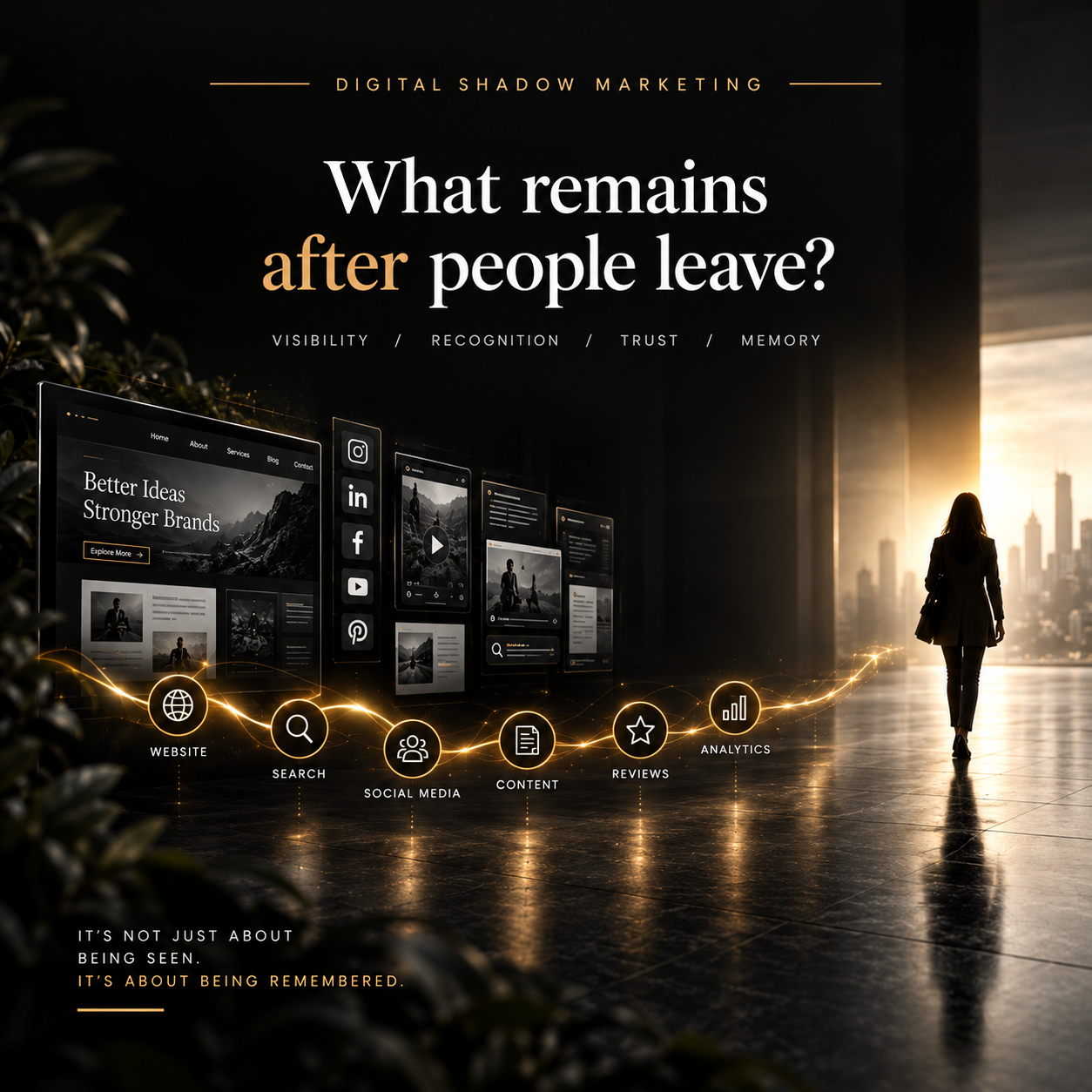
That leads to a concept I call the Digital Shadow.
Your digital shadow is the collection of impressions, associations, information, experiences and signals that remain with people after they leave your digital presence.
It is what your brand leaves behind.
And sometimes, that shadow influences the next search, the next visit, the next conversation—or eventually, the next decision.
Table of Contents
ToggleWhat Is a Digital Shadow?
A digital shadow is not a single post, website page or advertisement.
It is the combined impression created by your digital presence over time.
Imagine someone discovers your business through an Instagram post.
They do not contact you.
A few days later, they see your name again.
Then they encounter your website in Google.
Later, they read one of your articles.
A week after that, they see your profile while searching for a service.
Eventually, they remember your name when they actually need that service.
No individual interaction necessarily produced a visible conversion.
But together, they created familiarity.
That accumulated presence is what this article calls the Digital Shadow.
Digital Shadow =
Presence + Information + Recognition + Experience + Memory
The idea changes the way we think about digital marketing.
Instead of asking only:
“Did this post convert?”
we can also ask:
“What did this post contribute to the person’s perception of the brand?”
The Problem With Measuring Everything Immediately
Digital marketing has become increasingly measurable.
We can track:
-
- Impressions
-
- Reach
-
- Clicks
-
- Engagement
-
- Website visits
-
- Leads
-
- Conversions
-
- Watch time
-
- Search traffic
-
- Returning visitors
These metrics are useful.
But they do not always capture the entire human journey.
Consider two people.
Person A
Sees your post → clicks → contacts you.
Person B
Sees your post → leaves → searches your name later → visits your website → reads an article → follows you → returns several weeks later → contacts you.
Person A has a simple measurable journey.
Person B has a longer digital journey.
The second journey may contain several interactions that appear disconnected when viewed individually.
This is why digital marketing should not be evaluated only through isolated moments.
Sometimes the sequence matters more than the individual signal.
The Digital Shadow Is Built in Layers
Your digital shadow does not come from one platform.
It is created by the collection of experiences people encounter across your digital ecosystem.
Think of it as six layers.
1. The Identity Layer
This answers:
Who are you?
Your:
-
- Name
-
- Brand
-
- Logo
-
- Professional title
-
- Website
-
- Profile descriptions
-
- Visual identity
-
- Areas of expertise
should communicate a reasonably consistent identity.
When someone encounters you in different places, they should be able to recognize that these digital properties belong to the same person or brand.
2. The Knowledge Layer
This answers:
What do you know?
Your blog posts, guides, videos, educational posts and explanations contribute to this layer.
A person may not remember every sentence you publish.
But they may remember:
“This person understands SEO.”
or:
“This business knows how to explain complicated things clearly.”
That association becomes part of your digital shadow.
3. The Evidence Layer
This answers:
Can I believe what you say?
Evidence can include:
-
- Portfolio projects
-
- Case studies
-
- Reviews
-
- Testimonials
-
- Demonstrations
-
- Certifications
-
- Original work
-
- Educational content
-
- Client outcomes
-
- Professional experience
Marketing claims become stronger when people can find supporting evidence.
4. The Experience Layer
This answers:
What was it like interacting with you?
A beautiful Instagram profile cannot compensate for a confusing website.
A strong advertisement cannot completely repair a poor customer experience.
A professional website cannot replace unclear communication.
Every interaction contributes to the experience people associate with your brand.
5. The Recognition Layer
This answers:
Do I remember you?
Recognition is created through repeated exposure and consistent meaning.
Not necessarily by repeating the same post.
Instead, the audience repeatedly encounters the same core identity expressed through different content.
For example:
Your blog teaches.
Your Instagram explains.
Your Reel demonstrates.
Your website positions.
Your portfolio proves.
Different formats.
One identity.
6. The Memory Layer
This is where the digital shadow becomes especially interesting.
A person may forget the exact headline.
They may forget the date.
They may forget where they saw you.
But they may remember:
your name
your style
your expertise
your message
your visual identity
the problem you helped them understand
That remaining memory can become valuable later.
Your Website Is Not Just a Destination
Many businesses still treat their website as a place people visit after seeing an advertisement.
But your website can function as the central memory hub of your digital shadow.
Your social media introduces you.
Your content demonstrates your thinking.
Your search presence helps people discover you.
Your reviews provide evidence.
Your website connects those pieces.
This makes the website more than a digital brochure.
It becomes the place where fragmented signals can become a coherent identity.
Google itself now describes Search profiles as a way to bring together content from across the web and social platforms into one destination.
That reflects a broader shift:
Digital identity is becoming increasingly distributed across multiple platforms.
The Shadow Is Bigger Than Your Social Media Feed
A common mistake is to think:
Digital presence = social media
It is much larger than that.
Your digital shadow may include:
Website
↓
Google Search
↓
Social media
↓
Images
↓
Videos
↓
Reviews
↓
Professional profiles
↓
Blog articles
↓
Directories
↓
Community discussions
↓
Search profiles
↓
AI-powered discovery
A person may encounter only a few of these.
But together they form the larger environment surrounding your brand.
Search itself is becoming more multimodal. Google announced in September 2026 that Search Console reporting now includes web multimodal search interactions such as Lens, Circle to Search, image uploads and “Search this image.”
That means the digital shadow is no longer purely text-based.
Images can contribute.
Videos can contribute.
Visual identity can contribute.
Profiles can contribute.
Experiences can contribute.
The Memory Gap
There is often a gap between seeing and choosing.
Someone can discover you today and choose you months later.
This is the Memory Gap.
Discovery
“I have seen this person before.”
Recognition
“I know this name.”
Familiarity
“I understand what they do.”
Confidence
“They seem knowledgeable.”
Intent
“I need this service.”
Action
“I will contact them.”
The mistake is assuming that every piece of content must immediately push someone toward the final stage.
Sometimes content has another job:
to prepare the mind for a future decision.
The Digital Shadow Formula
For this framework, we can think of the digital shadow as:
DS = I + K + E + X + R + M
Where:
I = Identity
Who you are.
K = Knowledge
What you teach or communicate.
E = Evidence
What supports your claims.
X = Experience
What people experience when interacting with you.
R = Recognition
How easily people identify you again.
M = Memory
What remains after the interaction ends.
The formula is not a scientific measurement.
It is a strategic way of thinking about digital presence.
From Content Calendar to Shadow Calendar
Most marketers plan:
Monday → Post
Wednesday → Reel
Friday → Carousel
But a stronger question is:
What should this month’s content leave behind?
That creates a Shadow Calendar.
Instead of planning only content formats, plan the perception you want to build.
Week 1 — Introduce
Show who you are and what you understand.
Week 2 — Educate
Solve a real problem.
Week 3 — Demonstrate
Show how you think or work.
Week 4 — Prove
Provide evidence, examples or results.
The objective is not simply to publish four pieces of content.
The objective is to leave behind four connected impressions.
The Content Shadow Test
Before publishing a piece of content, ask five questions:
1. What does this teach?
If someone remembers only one idea, what should it be?
2. What does this reveal?
Does it show your thinking, personality, process or perspective?
3. What does this prove?
Does it provide evidence of expertise or experience?
4. What does this reinforce?
Does it strengthen your existing brand identity?
5. What could remain?
If someone forgets the post tomorrow, what should they still remember?
If you cannot answer the final question, the content may not be creating a meaningful shadow.
The Shadow of a Personal Brand
For personal brands, the Digital Shadow becomes even more important.
People are not only evaluating:
“What service does this person offer?”
They are also forming impressions about:
-
- How this person thinks
-
- How this person communicates
-
- What this person values
-
- Whether this person understands the subject
-
- Whether this person appears reliable
-
- Whether this person has practical knowledge
-
- Whether this person feels authentic
For a freelance professional, every blog article, portfolio project, social post and professional profile contributes to this perception.
Your digital presence gradually becomes a digital portrait of your professional identity.
The Shadow of a Small Business
A small business does not necessarily need to dominate every platform.
It needs to become recognizable and understandable to the right audience.
Imagine a local business whose potential customer encounters:
-
- A useful Instagram Reel
-
- A helpful Google result
-
- A clear website
-
- Genuine customer reviews
-
- Consistent branding
-
- Useful educational content
-
- Easy contact information
Each element may appear ordinary on its own.
Together, they create something stronger:
confidence through accumulated evidence.
This is particularly relevant as consumer discovery increasingly moves across search, social platforms and other digital touchpoints. Current research on Indian consumers also examines how digital marketing, trust, social media and website experiences interact during purchase decisions.
The Shadow of AI-Generated Content
Artificial intelligence has made content production faster.
But faster production creates another challenge:
similarity.
When thousands of businesses can generate similar captions, generic articles and predictable marketing messages, simply publishing more content does not necessarily create a distinctive identity.
This makes the Digital Shadow more important.
Your strongest differentiators may become:
-
- Original experiences
-
- Specific examples
-
- Personal insights
-
- Unique processes
-
- Genuine opinions
-
- Demonstrated expertise
-
- Consistent positioning
-
- Human stories
AI can help produce content.
But your digital shadow is shaped by what makes that content recognizably yours.
The Shadow Principle
Here is the central principle of this framework:
Don’t create content only for the moment it is seen. Create content for what remains after it is forgotten.
That changes the creative process.
Instead of asking:
“Will this get attention?”
also ask:
“Will this create recognition?”
Instead of:
“Will people like this?”
ask:
“Will people understand something useful?”
Instead of:
“How many people reached this post?”
ask:
“What did this post add to my brand?”
These questions move digital marketing from content production toward brand construction.
How to Build a Stronger Digital Shadow
You do not need to publish everywhere.
Start with consistency.
Build one clear identity
Use a recognizable professional description across your important platforms.
Create connected content
Let your blogs, social posts and videos support related themes.
Show evidence
Don’t only say what you can do.
Show your thinking and work.
Make your website useful
Give visitors reasons to explore beyond the homepage.
Repeat your core ideas
Repetition creates recognition when the underlying message remains consistent.
Develop visual consistency
Colors, typography, imagery and design can make recognition easier.
Create original perspectives
Do not rely entirely on generic information that hundreds of other websites already provide.
Measure more than immediate conversions
Track meaningful signals such as returning visitors, branded searches, enquiries, saves, shares and content-assisted journeys alongside conventional performance metrics.
A Digital Shadow Audit
You can audit your own digital presence using this simple checklist.
| Layer | Question |
|---|---|
| Identity | Is it obvious who I am? |
| Expertise | Is it clear what I know? |
| Evidence | Can people verify my claims? |
| Experience | Is interacting with my brand easy? |
| Recognition | Can people recognize me across platforms? |
| Memory | Is there something distinctive to remember? |
| Consistency | Does everything feel connected? |
| Conversion | Is the next step clear? |
If one layer is weak, your overall digital presence may feel fragmented.
The Future of Digital Marketing May Be About What Remains
Digital marketing has spent years becoming better at capturing attention.
The next challenge is different.
What happens after attention?
A person sees.
Then they interpret.
Then they remember.
Then they encounter you again.
Then they recognize you.
Then they trust you.
Then, perhaps much later, they act.
That journey is difficult to see when marketing is reduced to individual posts and isolated metrics.
But it becomes easier to understand when we look at the entire digital presence as an ecosystem.
That ecosystem creates a shadow.
And the quality of that shadow matters.
Final Thought
Your audience will not remember everything you publish.
They do not need to.
They only need to remember enough.
Enough to recognize your name.
Enough to understand what you do.
Enough to associate you with a particular area of expertise.
Enough to remember the value you provided.
Enough to return when the need appears.
That is the deeper purpose of digital marketing.
Not simply to be seen.
Not simply to be clicked.
But to leave something meaningful behind.
Your content may disappear from someone’s screen in seconds. Your digital shadow can remain much longer.
In an increasingly crowded digital world, the question may no longer be:
“How loud is your brand?”
It may be:
“What remains after the noise disappears?”
The Digital Shadow Framework
IDENTITY
Who are you?
↓
KNOWLEDGE
What do you know?
↓
EVIDENCE
What can you show?
↓
EXPERIENCE
What do people experience?
↓
RECOGNITION
Will they know you when they see you again?
↓
MEMORY
What remains?
That is your Digital Shadow.
A Note From a Digital Marketer
As digital platforms continue to change, I believe businesses should think beyond individual posts, campaigns and short-term visibility.
A strong digital presence should create a connected experience—one that helps people discover, understand, remember and eventually trust a brand.
For me, digital marketing is not simply about being visible.
It is about making that visibility meaningful.
Because the strongest digital presence is not always the one people notice for the longest time.
It is the one they remember when it matters.
Let’s Build Your Digital Presence
If you are looking to strengthen your website, SEO, social media presence, content strategy or overall digital identity, let’s create a strategy designed around your audience and business goals.